
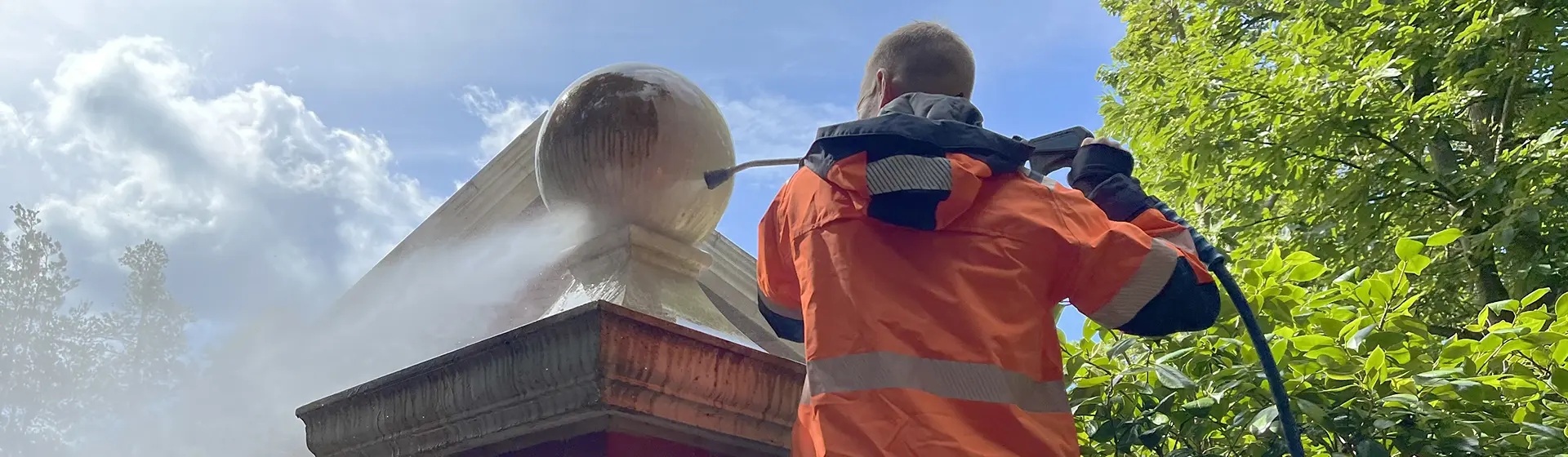
Start with the material or the part of the building that needs attention. You do not need to identify the stone yourself: photographs can help us advise on the next assessment step. Water Marsh works on residential, historic and commercial stonework across Surrey, Sussex and Hampshire.
What stone do you have?
Portland stone
This limestone appears on façades, public buildings and detailed masonry. Carbon deposits, sheltered black crusts, algae and water-run marks may occur. Assess the surface beneath any crust and previous repairs before deciding the level of cleaning; retained weathering may be appropriate.
Bath stone
A warm-coloured limestone often used for period buildings and carved details. Check for powdering, soft edges and weathered surfaces as well as dirt and biological growth. Friable areas may need stabilisation before cleaning; increasing pressure is not an answer to a fragile surface.
Other limestone
Limestones differ in texture, porosity and weathering. Pollution, biological growth, salts and mineral crusts need separate assessment. Acidic products can attack calcareous stone, so a product intended for another type of masonry must not be assumed suitable.
Sandstone
Sandstones vary considerably in composition and condition. Identify whether dark marks are pollution or growth, and check for iron staining, weak layers and previous coatings. Product compatibility and a representative test area matter; a successful method on one sandstone does not establish suitability for another.
Yorkstone
Often found on steps, entrances, copings and paving. Dirt, algae, lichen and worn surfaces need to be distinguished. Assess the stone and joints together; cleaning will not reverse worn treads, delamination or physical loss. Nearby access and drainage also affect the plan.
Granite
Used for cladding, columns, plinths, monuments and other features. Pollution and biological growth can affect even durable stone. Check the finish, joints, fixings and any absorbed stains before treatment; a polished surface needs a different assessment from a rough-textured one.
Marble
Often used for entrances, columns, memorials and decorative work. Acidic products can etch its surface. Cleaning must preserve the intended finish as well as the stone; existing etching, wear or weathering may need a separately scoped restoration process.
Travertine
A limestone with a naturally open structure, sometimes filled or finished. Assess voids, fillers, joints and coatings as well as the contamination. The aim is to clean the surface appropriately without treating natural texture or failed filler as dirt.
Slate
Found in cladding, sills, steps and architectural details. Check the finish and any separating layers, damaged edges or previous coatings. Cleaning cannot repair delamination; the proposed process should reflect the condition of each feature.
Cast and reconstituted stone
Manufactured stone may closely resemble natural material. Composition, aggregate, coatings and condition affect treatment. Identify it before selecting a process, especially where it sits alongside limestone, brick or ceramic details on the same façade.
Terracotta and faience
These are ceramic materials, rather than natural stone. Glazed and unglazed surfaces need their own assessment, including cracks, damaged glaze and joints. Abrasive treatment may permanently alter the finish; adjacent natural stone does not justify using the same method.
What part of the building needs cleaning?
Projecting ledges collect water and contamination, while sheltered areas may retain deposits that rain does not wash away. Recesses in carvings and capitals can need a different approach from a flat elevation.
Façades, cladding and masonry
Complete elevations, stone fascia and façade details, cladding panels, ashlar masonry, rusticated stonework and coursed masonry can contain several stone types and past repairs. We assess representative areas, exposure, access and the cleaning sequence rather than assuming the entire elevation behaves alike.
Copings, parapets and horizontal courses
Copings and coping stones, parapets, cornices, string courses and band courses receive or redirect water. Examine staining paths, joints and damaged copings. Sheltered undersides and exposed faces may have different deposits; cleaning does not correct defective water shedding.
Columns and balustrades
Columns and pillars, capitals, column bases, pilasters, balustrades and individual balusters combine exposed edges with sheltered recesses. Fine profiles and weakened joints need care. Cleaning should retain sound detail rather than chase uniform colour through every recess.
Porticos, surrounds and entrances
Porticos, pediments, door and window surrounds, sills, lintels and heads, arches, architraves, quoins and plinths often combine several surfaces. Assess adjacent glazing, metalwork, paint and jointing when planning protection and treatment.
Steps and thresholds
Stone steps, staircases, entrance steps and thresholds may show ingrained dirt, algae and traffic wear. Check worn edges and joints first, and plan access while work is underway. Cleaning may improve the surface appearance, but worn or damaged stone is a separate issue.
Carved and decorative stone
Carvings, decorative mouldings, corbels, brackets, keystones, finials, ball finials, urns, coats of arms and crests have delicate projections and recesses. Condition and previous repairs govern the approach. Loss of detail cannot be reconstructed by cleaning.
Statues, inscriptions and memorials
Statues, sculptures, plaques, inscriptions, memorials and monuments may carry historic finishes or fragile lettering. Establish significance and condition before deciding what to remove. A restrained finish may be more appropriate than removing every visible trace of age.
Walls, gateways and church details
Boundary walls, retaining walls, gate piers, pier caps, stone entrances and gateways need assessment of water paths and joints. Church stonework, architectural tracery, mullions and transoms also require attention to fine edges, glazing and access. Feature stonework is assessed individually.
Staining or deterioration?
Surface contamination
We assess carbon and traffic pollution, black crusts, algae, moss, lichen and dark biological growth; salts, lime and calcium deposits; rust, iron and copper staining; bird fouling, ivy marks, paint, graffiti, oil, grease, mortar and cement residues; soot, smoke and water-run marks. Colour alone is not a diagnosis. Different deposits on the same building may require separate treatments.
Sulphation and gypsum crusts
Pollution-related crusts can be associated with changes to the stone surface itself. Where a crust is closely bound to weakened stone, complete removal may sacrifice material. Assessment and a carefully agreed level of cleaning take priority over a uniformly bright finish.
Flaking, powdering and lost detail
Flaking, scaling, powdering, friability, spalling, delamination and loss of carved detail indicate deterioration. Cleaning can worsen an unstable surface. Stabilisation may be needed first, and some areas may be unsuitable for cleaning.
Cracks, joints and previous repairs
Cracks and fractures, open or failed mortar joints, inappropriate cement repairs, failed coatings, damaged copings and corroding fixings need separate assessment. Previous aggressive cleaning can also leave permanent damage. Cleaning cannot correct these defects or replace eroded stone.
A cleaning plan for your stonework
We assess the material, contamination, condition and previous treatments. DOFF, TORC or other specialist methods may be considered, individually or in combination. Trial areas help establish a suitable method and the expected finish. Delicate detail, vulnerable joints and neighbouring materials influence the plan.
For historic or complex projects, the scope and sample areas can be discussed with the architect, surveyor, conservation professional or main contractor. Tell us about listed or protected status and project requirements before work is agreed. A cleaning system is not, by itself, approval for work to a building.
Send us photographs of your stonework
Include overall views, close-ups of the material and staining, your postcode and access routes. Point out loose areas, repairs and known previous treatments. We can advise whether photographs are enough for an initial quotation or whether a survey and test area are needed.